


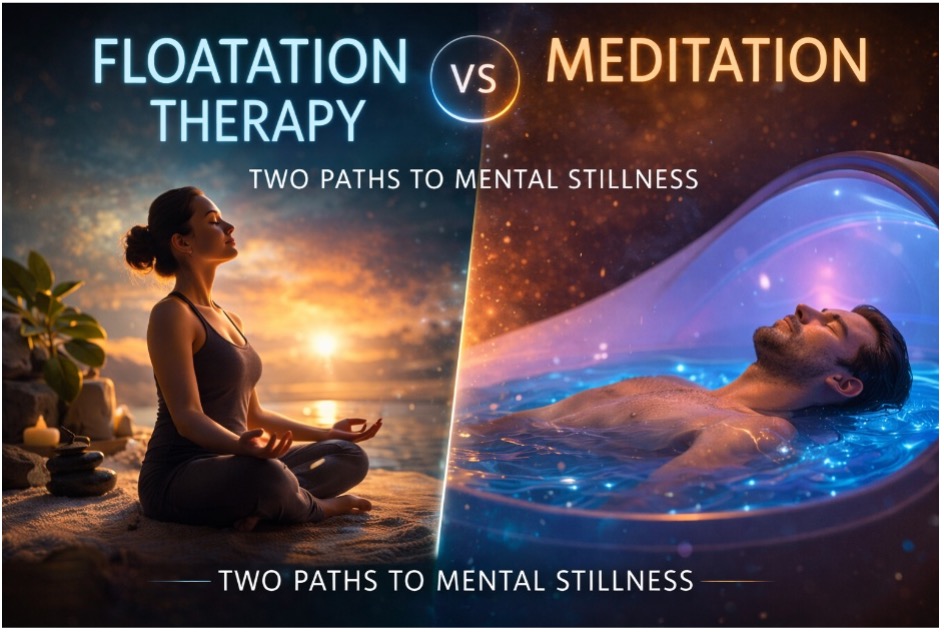
15 Mar Floatation Therapy vs Meditation: Which Is Better?
Meditation has been practiced for thousands of years as a way to calm the mind, reduce stress, and cultivate awareness. In recent years, floatation therapy, sometimes called sensory deprivation therapy, has gained attention as another powerful tool for relaxation, mental clarity, and nervous system recovery.
As more people discover float tanks, a common question naturally arises:
Is floatation therapy better than meditation?
The reality is that floatation therapy and meditation are not competing practices. In fact, they complement each other extremely well. While meditation trains the mind to find calm despite distractions, floatation therapy creates an environment where deep calm can occur naturally.
Understanding the differences between these two practices can help you decide which approach may work best for you—or how combining them might create the most powerful experience.
What Is Meditation?
Meditation is the practice of focusing attention and awareness to cultivate a state of mental clarity, emotional balance, and presence.
Most meditation techniques involve sitting quietly while focusing on one of several anchors for awareness, such as:
- breathing
- bodily sensations
- a mantra or phrase
- observing thoughts without judgment
Research has consistently shown that meditation can provide significant benefits, including:
- reduced stress and anxiety
- improved emotional regulation
- better concentration and focus
- improved sleep
- increased self-awareness
However, meditation can be challenging for beginners. Many people struggle with racing thoughts, environmental distractions, or physical discomfort when they first begin practicing.
Developing a stable meditation practice often requires patience and consistent training over time.
What Is Floatation Therapy?
Floatation therapy takes place inside a specially designed float tank or pod filled with warm water and a very high concentration of Epsom salt (magnesium sulfate).
Because of the salt density, the body floats effortlessly on the water’s surface. The water temperature is set to match skin temperature, making it difficult to distinguish where the body ends and the water begins.
Inside the float tank:
- light is minimized or eliminated
- sound is greatly reduced
- gravity pressure on the body disappears
- external stimulation drops dramatically
This environment produces a condition known as Reduced Environmental Stimulation Therapy (REST).
Without the constant stream of sensory input the brain normally processes, the nervous system begins to relax and the mind often becomes noticeably quieter.
Many people report that floating produces a state very similar to deep meditation.
The Key Difference: Effort vs Environment
The fundamental difference between meditation and floatation therapy lies in how the relaxed state is achieved.
Meditation relies primarily on mental training, while floatation therapy relies on environmental design.
Meditation
When meditating, the practitioner learns to calm the mind even while external distractions still exist.
This requires practice in managing:
- wandering thoughts
- sounds and distractions
- bodily discomfort
- emotional fluctuations
Over time, experienced meditators become skilled at maintaining awareness regardless of what is happening around them.
Floatation Therapy
Floatation therapy removes many of those distractions entirely.
Inside the float tank:
- there is little to no external sound
- there is minimal visual stimulation
- the body experiences weightlessness
- physical tension decreases
Because the brain has far fewer sensory signals to process, the mind naturally begins to slow down.
For many people, this allows them to reach a meditative state with far less effort.
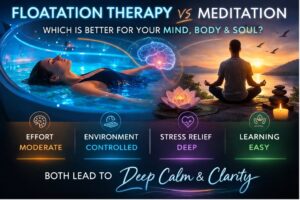
Comparison: Floatation Therapy vs Meditation
| Feature | Meditation | Floatation Therapy |
| Effort Required | Moderate to High (especially for beginners) | Low |
| External Distractions | Present | Minimal |
| Learning Curve | Requires practice and discipline | Easy to begin |
| Physical Comfort | Sitting posture required | Weightless floating |
| Stress Reduction | Strong | Very strong |
| Nervous System Reset | Gradual | Often immediate |
| Meditation Depth | Improves with experience | Often occurs naturally |
Both practices can produce powerful mental and physical benefits. The key difference is that meditation trains the mind to create calm internally, while floating creates the conditions where calm emerges naturally.
Why Floating Can Make Meditation Easier
One of the most common things first-time float clients say after their session is:
“That was the quietest my mind has ever been.”
This happens because floatation therapy removes many of the external stimuli that normally compete for attention.
Meditation asks you to quiet your mind despite distractions.
Floatation therapy simply removes many of the distractions altogether.
For beginners who struggle with meditation, floating can provide the first experience of true mental stillness.
Over time, many people find that floating actually strengthens their ability to meditate outside the tank.
The Nervous System Connection
Both meditation and floatation therapy influence the parasympathetic nervous system, which controls the body’s relaxation and recovery processes.
When this system becomes dominant:
- heart rate slows
- breathing deepens
- muscle tension decreases
- stress hormones decline
Meditation activates this system through breath awareness and focused attention.
Floatation therapy activates it by dramatically reducing sensory input and allowing the body to experience weightlessness.
Both approaches can help shift the body out of the fight-or-flight stress response and into a healing state.
Which One Is Better?
The honest answer is that neither practice is inherently better.
They simply work through different mechanisms.
Meditation develops mental discipline and awareness that can be applied anywhere.
Floatation therapy creates an ideal environment where relaxation and meditation-like states occur naturally.
For many people, the most powerful approach is combining the two.
Floating can help people experience deep states of relaxation and awareness, while meditation can help maintain those states in everyday life.
Who Benefits Most from Floatation Therapy?
Floatation therapy can be especially beneficial for people who struggle with traditional meditation.
It may be particularly helpful for:
- individuals experiencing chronic stress or anxiety
- people new to meditation
- athletes seeking mental and physical recovery
- entrepreneurs and creatives seeking mental clarity
- anyone seeking deeper relaxation
Because the float tank removes many distractions, it can provide what feels like a shortcut into a meditative state.
Floating and Inner Exploration
Beyond relaxation and stress relief, many people find that floatation therapy creates a powerful environment for self-reflection and inner awareness.
With the outside world temporarily quieted, the mind often becomes clearer and more open.
Some people report experiencing:
- vivid visualization
- creative inspiration
- emotional processing
- deep meditative awareness
These experiences have inspired many individuals exploring consciousness and personal growth—including ideas explored in the book Veilwalker, which examines how sensory-reduction environments like float tanks can support expanded awareness and inner exploration.
Experience Floatation Therapy for Yourself
Meditation and floatation therapy both offer powerful ways to restore balance in an increasingly noisy and stressful world.
Rather than choosing one over the other, many people discover that the two practices complement each other beautifully.
Meditation trains the mind.
Floating creates the environment where the mind can finally rest.
If you’re curious about experiencing floatation therapy for yourself, the best way to understand its benefits is simply to try it.
At Synergy Float Center in Alexandria, Virginia, and Synergy Float Spa on Florida’s Space Coast, our mission is to help people reset their nervous systems, optimize their health, and reconnect with themselves.
For those interested in exploring the deeper relationship between consciousness, meditation, and sensory environments, floatation therapy is also a central theme in the book Veilwalker.
Sometimes the path to clarity doesn’t require doing more.
Sometimes it simply requires stepping away from the noise… and allowing yourself to float.