


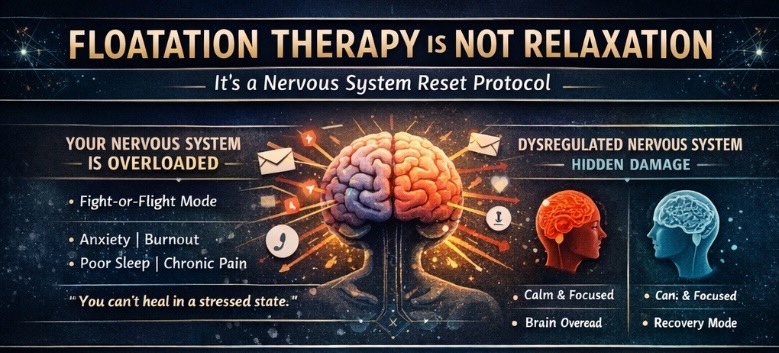
31 Mar Floatation Therapy Is Not Relaxation — It’s Nervous System Medicine
For decades, floatation therapy has been misunderstood.
Marketed as a “spa experience” or a tool for relaxation, it has been placed in the same category as massages and facials. But emerging research—and a deeper understanding of human physiology—suggests something far more significant:
Floatation therapy is not a luxury. It is a neurological reset.

Why Your Nervous System Is Failing You (And It’s Not Your Fault)
Modern humans are living in a state of chronic sympathetic dominance—the “fight or flight” branch of the autonomic nervous system. This system was designed for short bursts of survival, not constant activation.
Yet today, it is perpetually engaged.
Deadlines. Notifications. Traffic. Financial stress. Information overload.
The result?
- Elevated cortisol levels
- Chronic inflammation
- Anxiety and depression
- Sleep disruption
- Cognitive fatigue
From a clinical perspective, this is nervous system dysregulation—a condition where the body loses its ability to efficiently shift between stress (sympathetic) and recovery (parasympathetic) states.
And here’s the key insight:
You cannot heal, recover, or optimize performance in a dysregulated nervous system.
Floatation Therapy: A Direct Intervention on the Nervous System
Floatation-REST (Reduced Environmental Stimulation Therapy) is not simply “relaxing”—it is a targeted neurological intervention.
By eliminating external sensory input—light, sound, gravity, and tactile pressure—floatation therapy reduces the load on the central nervous system itself.
Research shows that floatation therapy:
- Reduces sensory input to the brain, allowing the nervous system to downshift
- Decreases sympathetic (stress) activation and increases parasympathetic activity
- Produces significant reductions in anxiety, stress, and pain
- Creates measurable improvements in mood, sleep, and overall well-being
In fact, studies demonstrate that floatation therapy shifts the autonomic nervous system toward parasympathetic dominance, the exact state required for healing, recovery, and regeneration.
This is not relaxation.
This is neurophysiological recalibration.
Why “Relaxation” Is the Wrong Frame
Relaxation is a subjective experience.
Nervous system regulation is a biological process.
Floatation therapy works because it removes all external demands on the brain, allowing it to:
- Reduce amygdala activity (fear/stress processing)
- Lower cortisol and stress biomarkers
- Increase interoceptive awareness (awareness of internal state)
This creates a state that is extremely difficult—if not impossible—to achieve in normal environments.
Even meditation requires effort.
Floating removes effort entirely.
The Consequences of NOT Resetting Your Nervous System
This is where the conversation becomes critical.
Because if floatation therapy is a tool for nervous system regulation, then the absence of regulation comes with real consequences.
Chronic nervous system dysregulation is associated with:
- Persistent anxiety and burnout
- Chronic pain syndromes
- Sleep disorders
- Reduced immune function
- Cognitive decline and poor decision-making
Research consistently links stress dysregulation to both mental and physical health deterioration over time.
In other words:
Ignoring your nervous system is not neutral—it is cumulative damage.
Why Frequency Matters (And Why One Session Isn’t Enough)
Many people try floating once and label it as “interesting” or “relaxing.”
But clinical and experimental research suggests something more important:
Repeated sessions produce compounding effects.
- Multi-session studies show sustained reductions in anxiety symptoms over time
- Clinical trials demonstrate benefits lasting up to 48 hours or longer after sessions
- Participants naturally choose longer and repeated sessions when given flexibility, suggesting intrinsic neurological benefit
This aligns with how the nervous system actually works:
Regulation is not a one-time event. It is a regular practice.
Reframing Floatation Therapy: From Luxury to Requirement
We schedule workouts for physical health.
We plan meals for metabolic health.
But most people do nothing to actively regulate their nervous system.
That’s the gap.
And that’s where floatation therapy belongs—not as an occasional indulgence, but as a core pillar of human optimization.
The Bottom Line
Floatation therapy should not be positioned as:
- A spa experience
- A relaxation tool
- A luxury service
It should be understood as:
A repeatable, non-pharmacological intervention that restores balance to the human nervous system.
And in a world where chronic stress is the baseline…
That’s not optional.
Make Time for yourself!
Integration and Practice
If you are serious about optimizing your mind, body, and consciousness, you cannot ignore the state of your nervous system.
At Synergy Float Spa and Synergy Float Center, floatation therapy is not treated as a luxury—it is treated as a tool for transformation.
Book Now:
www.synergyfloatcenter.com in the Washington D.C. Metro Area
www.synergyfloatspa.com on Florida’s Space Coast.
If you are not located in these areas, find your closest center Map – Floatation Locations
And if you’re exploring deeper awareness, consciousness, or what lies beyond the veil…
This is where it begins, www.veilwalkerlearning.com
References
Feinstein, J. S., Khalsa, S. S., Yeh, H., Wohlrab, C., Simmons, W. K., Stein, M. B., & Paulus, M. P. (2018). Examining the short-term anxiolytic and antidepressant effect of Floatation-REST. PLOS ONE, 13(2), e0190292.
Flux, M. C., et al. (2022). Exploring the acute cardiovascular effects of Floatation-REST. Frontiers in Neuroscience.
Garland, M. M., et al. (2024). A randomized controlled safety and feasibility trial of floatation-REST in anxious and depressed individuals. PLOS ONE, 19(6).
Kjellgren, A., et al. (2014). Beneficial effects of treatment with sensory isolation in flotation tanks. BMC Complementary Medicine and Therapies.
Tran, K. (2021). Floatation therapy for mental health conditions. NCBI Bookshelf.