


10 Mar Floatation Therapy: The Most Powerful Wellness Solution You’ve Probably Never Heard Of
In a world filled with stress, noise, and constant stimulation, people are searching for ways to slow down, relax, and reconnect with themselves. Meditation apps, supplements, and wellness trends promise relief, yet many people still struggle to quiet their minds and truly reset their nervous systems.
 Ironically, one of the most powerful wellness tools has existed for decades—but most people have never heard of it.
That solution is floatation therapy.
Used by neuroscientists, elite athletes, meditation practitioners, and high performers, floatation therapy creates something that is almost impossible to find in modern life: complete sensory stillness.
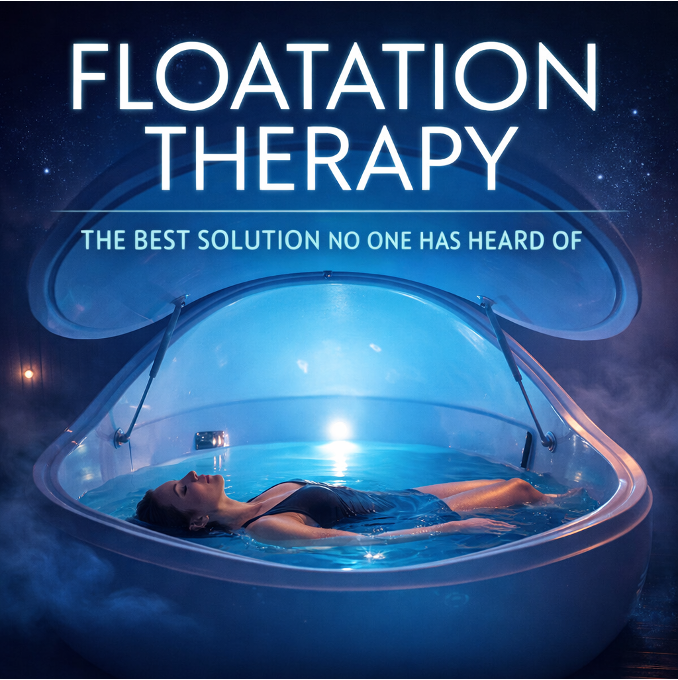
Inside a float tank filled with warm water and over 1,000 pounds of Epsom salt, the body floats effortlessly while light, sound, and gravity fade away. In this environment, the nervous system finally has the opportunity to reset.
For many people, the experience becomes the deepest relaxation they have felt in years.
What Is Floatation Therapy?
Floatation therapy, sometimes called sensory deprivation therapy, takes place inside a specially designed float tank or pod filled with warm saltwater.
Because the water contains a very high concentration of Epsom salt (magnesium sulfate), the body floats effortlessly on the surface without any effort or tension. The water temperature is carefully regulated to match skin temperature, making it difficult to distinguish where your body ends and the water begins.
Once inside the float tank, external stimulation is minimized.
There is little to no light.
There is little to no sound.
Gravity pressure on the body disappears.
This dramatically reduces sensory input to the brain and allows the nervous system to move away from the fight-or-flight stress response into the parasympathetic healing state.
Many people report experiencing:
- deep relaxation
• quiet mental clarity
• reduced anxiety and stress
• improved sleep
• enhanced creativity and problem solving
For people who struggle to meditate or relax, floatation therapy often provides the first time they have truly experienced mental stillness.
Why Floatation Therapy Works So Well
Modern life constantly stimulates the brain.
Phones, screens, traffic, notifications, and information overload keep the nervous system in a state of near-constant activation. Over time this contributes to anxiety, fatigue, burnout, and difficulty concentrating.
Floatation therapy removes those external inputs.
Researchers refer to this environment as Reduced Environmental Stimulation Therapy (REST), a condition where the brain receives far fewer external signals than normal.
When the brain is no longer processing thousands of sensory inputs, the nervous system can begin to self-regulate and restore balance.
Scientific research has shown that floatation therapy can help:
- reduce stress and anxiety
• improve mood and emotional regulation
• decrease muscle tension and pain
• support deeper meditation states
• improve mental recovery and creativity
Neuroscientist Dr. Justin Feinstein has conducted extensive research on floatation therapy and its effects on anxiety and stress disorders. His work suggests that floating can significantly calm the nervous system and help individuals experience a deep sense of safety and relaxation.
For many people, a single float session can feel like hours of restorative rest for the mind and body.
Why More People Haven’t Heard of It
Despite its powerful benefits, floatation therapy is still relatively unknown compared to other wellness practices.
There are several reasons for this.
First, it is difficult to fully explain until someone experiences it. Floating does not feel like massage, meditation, or spa therapy, it is something entirely unique.
Second, the float industry is still emerging. While float centers are growing rapidly around the world, the practice has not yet reached the mainstream awareness of yoga or massage therapy.
Third, the benefits of floating are subtle but profound. Instead of stimulating the body with external treatments, floating allows the body and brain to naturally restore balance on their own.
Those who discover floatation therapy often describe it as one of the most powerful hidden tools in the wellness world.
Who Benefits Most From Floatation Therapy?
Floatation therapy attracts people from many different backgrounds who are looking for recovery, clarity, or personal growth.
Some of the most common groups include:
People Experiencing Stress or Anxiety
Floating allows the nervous system to fully relax, often producing a deep sense of calm that can last for days.
Athletes and High Performers
Professional athletes use float therapy to accelerate recovery, reduce muscle soreness, and improve mental focus.
Meditation Practitioners
Many people find floating to be one of the easiest environments for entering deep meditation.
People with Chronic Pain
The buoyancy of the saltwater removes pressure from joints and muscles, allowing the body to relax in ways that are impossible on land.
Creatives and Entrepreneurs
The quiet mental space created during a float often leads to creative ideas, problem solving, and insight.
Floating as a Gateway to Inner Exploration
Beyond physical recovery and stress reduction, many people discover that floatation therapy creates a powerful environment for self-reflection and inner awareness.
When the outside world becomes quiet, the mind often becomes clearer.
Some people experience:
- deep meditation
• enhanced visualization
• emotional processing
• creative inspiration
• a stronger sense of connection with themselves
For individuals exploring consciousness, meditation, or spiritual growth, floating can become a gateway to deeper awareness.
This is one of the themes explored in the book Veilwalker, which examines how environments that reduce sensory input, such as float tanks, can help people access deeper layers of consciousness and perception.
What Your First Float Experience Is Like
Most float sessions last between 60 and 90 minutes.
After showering, you enter the float pod or tank and gently lie back into the warm water. The salt instantly supports your body, allowing you to float effortlessly.
During the first few minutes, the mind may still be active. But gradually the body begins to relax, breathing slows, and thoughts begin to quiet.
Many people describe the experience as drifting between meditation and sleep.
When the session ends, clients commonly report feeling:
- deeply relaxed
• mentally refreshed
• physically lighter
• emotionally balanced
The effects often last for several days.
Why Floatation Therapy May Be the Future of Wellness
As awareness of nervous system health grows, floatation therapy is gaining attention around the world.
It offers something extremely rare in modern wellness:
A technology designed to remove stimulation instead of adding more of it.
In a culture built on constant information, noise, and stress, the ability to temporarily disconnect may be one of the most valuable tools available for restoring balance.
For many people, floating becomes a regular practice for maintaining mental clarity, emotional health, and physical recovery.
Experience Floatation Therapy at Synergy
If you are curious about experiencing floatation therapy for yourself, the best way to understand it is simply to try it.
At Synergy Float Center in Alexandria, Virginia, and Synergy Float Spa on Florida’s Space Coast, our mission is to help people reset their nervous systems, improve their health, and reconnect with themselves.
Both locations offer multiple wellness modalities designed to help optimize mind, body, and spirit, with floatation therapy serving as the cornerstone experience.
Many clients describe their first float as the moment they finally experienced true stillness in a noisy world.
For those interested in exploring the deeper possibilities of consciousness, meditation, and inner exploration, floatation therapy is also a central theme in the book Veilwalker, which explores how sensory reduction environments like float tanks can open the door to expanded awareness.
If you’ve been searching for a way to slow down, recover, and reconnect with yourself, floatation therapy may be the powerful solution you simply haven’t heard of yet.